Showing posts with label wine. Show all posts

Sunday, October 2, 2011

Hold Me Closer Crafty Dancer

When the Crafty Bastard Art Fair rolled around we couldn't pass it up. We'd like to think we're pretty handy people, but inspiration can be a little elusive. Perhaps we could find some interesting things that we could make at home to spruce up our new abode.

Needless to say, Oscar was very excited. He's getting bigger and more adept at grabbing (along with lots of other things) and feels he is mature enough for some new toys. Not necessarily for a new skill set, but perhaps some new textures would be in order.

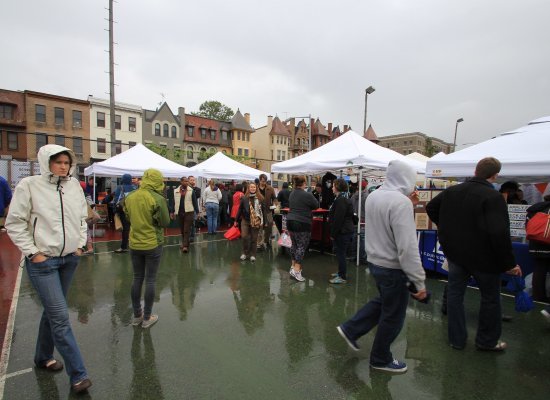
We dug around in his closet until we found some suitably warm clothes for the cold, windy, rainy ride to Adams Morgan.


Oscar bundled up for October's rainy, windy weather in DC

I'm not sure whose idea it was to have an outdoor craft fair in October, perhaps they are from Raleigh as well (like Rebecca). But there were plenty of people none the less.


Oscar was well protected on the way there...


There were plenty of interesting vendors and lots of baby friendly stuff for sale. We decided not to get any clothes since we have plenty already and he is growing too fast to wear anything for very long. There were some especially cute baby toys and stuffed animals.

Diane Koss' "Cutesy But Not Cutesy" booth was our favorite:


It even matches the color scheme of all the paintings that everyone did for him.

We didn't buy anything (yet), but we'll check out her Etsy store and find something for Oscar.

On the way home, we stopped by Whole Foods for fancy pork chops and box wine.

Having done some research, Whole Foods has the best selection of box wine in the District.


Box wine is much better than it used to be, with advances in material and packaging technology, wine can taste good and stay fresh in a bag-in-a-box for a few weeks. That means higher end winemakers are opting for the much less expensive bag/box packaging for mid-priced wines. Yeah for us!!!


Available for the equivalent of $5/bottle.

When we got home, it was just about time for Oscar's book/bath/massage bedtime routine. I think the bath is his favorite part, he's so excited, he has to do a dance when he gets out...

Saturday, May 30, 2009

Visitors...


Our visitors are arriving on the heels of each other. We said goodbye to Erika on Wednesday morning, and Trevor arrived with his bike in tow the same afternoon.


Erika's last day in our lovely apartment.


Hello Trevor...with Saturday afternoon oysters. (In case you're wondering what you're missing)


then a nap...


Late afternoon in Parc Blossac


Moules Frites and Muscadet


After all that relaxing, it's time for a trip to the bottle depository.

Stay tuned for more photos and info from the recent adventures and possibly some guest-authored posts.

Thursday, May 14, 2009

Graduate Travel Math

Now that we're older and wiser, we're getting more adept at taking advantage of the various transportation options that surround us here in France. This includes navigating the buggy, crash-prone, truly awful SNCF website. We recently visited Tours for an afternoon, with Jefe riding his bike the 116 km and Rebecca taking the TGV with an appropriate MFK Fisher book.

The bike ride north was fairly uneventful and Jefe made it to the main Tours train station (well, not exactly, more on that later) about 10 minutes before Rebecca showed up. We walked a few blocks through pedestrian streets to Rue Colbert, which is lined with restaurants and cafes. Thanks to a little research the night before on fra.cityvox.fr we knew of a couple restaurants on this street that were promising candidates.

We decided on Le Turon at 94 rue Colbert. They specialize in traditional recipes incorporating regional foods and their prices are pretty reasonable. Rebecca had a large salad with local specialties St. Maure goat cheese and chunks of fatty pork called rillons. Jefe opted for the full formule: terrine de Rillette, Perch with tagliatelle, and lemon sorbet.

Delightfully sated, we wandered over to Place Jean Jaurès and met Rebecca's colleague (and Tours resident) for coffee and a discussion of Tours sites and French foibles (they have too many national holidays in May, for example).

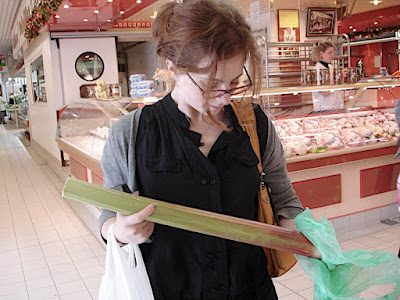
Post-coffee, Jefe went to the Centre de Création Contemporaire to check out Kasbah by Kader Attia while Rebecca wandered the pedestrian streets people-watching and window shopping. After reuniting we strolled through the twice-weekly flower market and stopped into Marché des Halles and found a spice booth selling Quinoa flour (hooray for gluten-free flours!) and a vegetable stand selling abnormally large, mutant rhubarb. It looked like a fossilized dinosaur femur and reminded Rebecca of that scene in Teenage Mutant Ninja Turtles film with the giant daisies and the ooze...

giant rhubarb in Tours
Giant rhubarb from Les Halles in Tours

In his endless quest for calories, Jefe also picked up some raspberry tiramisu at a stall selling Italian specialties.

After so much walking, we had to take a break, with wine of course. La Gazette des Halles (bistro/wine bar) was just across the street and offered inviting street-side tables. We got to sample a few local wines from Chinon and Touraine while enjoying the passing scenery until our train departure. The last drink was on the house!

When departing from (or arriving at) Gare de Tours (Tours' central train station), it is usually necessary to take a shuttle train to St. Pierre des Corps (the less centrally located train station) to catch the TGV to your destination. Apparently, the central train station is a little too central, and the since the train can't pull through (it has to back in) the time-pressed TGV doesn't want to spend the extra few minutes it would take to stop at the main station. Thus, all the TGV trains stop at St. Pierre des Corps, making it, essentially, Tours' primary train station. Which is kind of a shame, since the Gare de Tours is beautifully built and otherwise very convenient. In any case, Jefe took the opportunity on the 5 minute shuttle ride to dismantle his bike for getting on the TGV.

Jefe dismantling his bike on the shuttle to St. Pierre des Corps

Now that we can manage Tours' slightly convoluted train system, we're ready to go back to visit the annual Fêtes des Vins (wine festival) for samples of the regions wines and other gastronomic specialties along with lectures.

Emboldened by the weather and the local scenery and food, we had barely returned to Poitiers before we were planning our next bike+train day trip. This time south, to Angoulême. While we were waiting for a break in Rebecca's teaching schedule and the sunny weather to coincide, Jefe rode to Bellac and took the TER (Regional Express Transport) back to Poitiers to see some new territory and check out the bike-accessibility of the slower, smaller, TER trains.

Jefe's 142 km route to Bellac was clearly not the most direct route, but he designed it to investigate all those small, squiggly, green lines on the Michelin map just south of Bellac that indicated narrow roads, scenery, and large hills. He found some truly lovely sights.

view from the hills south of Bellac
The view from Les Monts de Blond into the department of Haut Vienne

The last train for Poitiers leaves Bellac at 6:08 pm, so Jefe had to start his ride from Poitiers at 10:30 am to leave enough time for a food break and slower riding through the scenic, hilly areas. The food break didn't happen on schedule as all the small-town grocers were closed for lunch until 3 pm or later instead of the expected 2 pm. When he finally found some food in St. Christophe, he was hungry enough to devour an armload of fruit.


2 oranges, 3 bananas and pear in front of a 12th century church

He also picked up a few savory pastries in Bellac at the local traiteur before boarding the train.

The TER trains were very comfortable and were bike-friendly, no disassembly required (the limit of 4 bikes per car was far from met).

bikes on the TER
Bike spaces on the TER

An hour and half later he was back in Poitiers, ready to eat more food.

Once the weather and Rebecca's schedule cooperated we were off to Angoulême. Jefe by this 133 km route and Rebecca by the afternoon train after a morning meeting at work. The wind forecast at France meteo was mistaken (their forecast of rain was also mistaken, and thus France meteo is getting deleted from the list of weather bookmarks) and Jefe was a little late to the rendez-vous after riding into a headwind for 5 hours.

We wandered the winding streets looking at murals from graphic novels/comic books (Angoulême is the site of a graphic novel/comic book museum and annual graphic novel expo)...

mural near Eglise St. Andre in Angouleme
Comic book mural in Angoulême

...sat in cafes sipping and people-watching and picked up some quinoa flakes at a health-food store. The young residents of Angoulême all seem hot on the trail of the latest trends. Besides some gel-enabled hairdos, we saw lots of examples of the return of 80's fashion that is so popular (see here, here, and here) as well as numerous fanny-pack-as-reversed-messenge-bag.

fanny packs coming back in Angoulême
Slightly blurry, but you can clearly see the fanny pack on the chest,
with strap worn over the shoulder


Dinner time arrived and we were off to La Cité to fulfill our increasingly frequent seafood cravings. It was delectably satisfying. We had salad with prawn tails and sautéed fresh foie gras, pan-fried goatfish in basil cream sauce and a skewer of prawns, shrimp and scallops. We can still taste it a day later, any more trips to Angoulême will definitely include a stop at this restaurant. We were so stupified by the delicious seafood, creamy sauces and wonderful wine, we had to belatedly dash out of the restaurant, running 4 blocks to the train station to catch the last train to Poitiers. We hopped on just a few seconds before the doors closed and Jefe quickly dismantled his bike aboard before the conductor approached and punched our tickets. A little sweaty and happy, we were glad to be heading back home to Poitiers for the night.

Wednesday, April 1, 2009

How to cook when you only work 35 hours per week...


Back in Illinois we have a cookbook of traditional French recipes (purchased long before we knew about our trip). It includes classics like coq au vin, bouillabaisse, cassoulet, and roulade of wild pheasant. Before coming here, we had only tried a very small number of the recipes. Most were very time consuming and/or required seemingly exotic ingredients.

The longer we spend in France, the less difficult these recipes seem and the less exotic the ingredients become. Making a terrine that takes three days, c'est normale! Making your own chicken stock, pourquoi pas? Finding duck fat, goose fat, chicken necks, rabbit, and horse are as easy as walking down the street.

Perhaps this newfound sense of time has something to do with Jefe not working at all, and Rebecca working a little less than she did in the U.S. Perhaps, the inexhaustable supply of excellent restaurants here have raised our standards a little for our own cooking.

There are a few things we now keep around that take home-cooking to the next level. Duck fat: available at all grocery stores and many specialty stores in France. Chicken stock: you might be shocked to find that it isn't for sale in grocery stores, but after you make this easy, delicious roast chicken recipe (adjust for gluten allergy as necessary), you can simmer the carcass and some vegetables and herbs in a pot for an hour or two, strain and store in jars in your fridge or freeze in an ice cube tray. Brown butter: butter that has been cooked until it turns a golden brown and develops a caramel, nutty flavor. Infused olive oils: herbs, or garlic boiled in olive oil and strained, and refridgerated.

homemade chicken stock

The visit of Jefe's brother and the ensuing restaurant testing in Poitiers and Paris lead to a few of these discoveries along with another new favorite: terrine. The word terrine can refer to either the cookware (like a loaf pan with a tight lid) or a chilled, compressed meatloaf that you would make in the aforementioned cookware. We tried a couple restaurants that offered their own take on this dish as an appetizer. It is made with various ground meats (uncured bacon, pork liver, and chicken liver are usually included) herbs and usually port or brandy. Often very aromatic, it is delicious with a side of cornichons and mustard.

In preparation for Jefe's parents, we made Country Terrine, using ground, uncured bacon from our favorite pork butcher Yves Henaud. The three-day prep was worth it. It smelled so nice and was a perfect addition to our regular mid-afternoon snack of cheese, artichokes, roasted beets, bread, and cornichons.

Country Terrine
we made a few changes to the recipe with our terrine,
including the use of local Calvados instead of regular brandy

And since the only canned beans available here are white beans, we've been buying bags of black beans (thanks to the exotic grocery store) and soaking them overnight in preparation for tacos. Tacos for which we make the tortillas by hand out of masa (thanks to Jefe's parents who brought a bag of masa from the U.S.) since real corn tortillas are unavailable here. The homemade tortillas are definitely worth the extra effort, they are fresher, fluffier, and taste delightful.


Jefe's dad demonstrating proper tortilla technique
You can hear the filmographer--Jefe's mom--asking the tough questions

Saturday, January 24, 2009

Bordeaux, Part I: Finest Food in Finest Town (?)


follow the wet cobblestones

In this, only our second francophone foray from Poitiers, we headed south to Bordeaux and Toulouse. Since both are fairly large and populous, and because we had never visited either place before, we did get guides (in French) for the two cities.

Really, a guidebook is just a starting point, something that you can use for the first day or so (maybe even just the first 4-6 hours). We feel the need to stress this point. The guidebook should be a handhold to use only until you get your hands on some local publications that will give you the lowdown on the currently hot restaurants, music venus, movies, art exhibits, and which may even warn you of an upcoming manif (slang for manifestation nf. 1. a protest, sometimes in conjunction with a strike or grève; 2. the national sport of France; 3. something you should know about before traveling).

Finding local reviews of what's going on is probably the most underrated travel-related activity. Guidebooks are ok for finding all the 1000+ year-old churches, but they aren't going to know about the organic Thai restaurant that just opened (or the little old theatre that just shut down). And if the locals aren't that into spicy organic food (a good bet around here), it may well be closed by the time the next edition of Lonely Planet comes out. This means that you, the traveler, have a responsibility to venture outside the safe confines of the published guidebook, which you should consider out-of-date and out-of-touch even before you spotted it on the bookshelf.

There is a reason the local publications review art, restaurants, movies, and fashion--locals want to know about this stuff too! In larger cities, local publications (for instance, Pariscope in Paris, The Reader in Chicago, Spirit in Bordeaux, or Let's Motiv if you're in Toulouse) give those out-of-the-way, non-corporate, and newly-opened, but still solid establishments a fighting chance against the overpriced robo-bistrots in the tourist district.

Enough of our hipster politics. 

So anyway, after our apartment almost burned down, we hopped on the TGV in Poitiers and were in Bordeaux in two hours, a short tram ride later, we were at our hotel. We'll never get over the ease of transferring from one form of transport to another here (TGV to bus/metro, airplane to TGV/bus/metro).  You know that feeling you get when you have to walk the five blocks from Chicago's Union Station to the nearest El stop dragging two suitcases in the snow? Well, not here!

In the middle of a vast network of streets for pedestrians and bikes only, we were surrounded by restaurants and boutiques. We found a great breakfast/lunch spot, Karl Restaurant, around the corner from our hotel.  

Karl--"Finest food in finest town"

Located in the Place du Parlement, the interior is very airy and the sun shines in the windows in the afternoon (well, theoretically.  If the sun ever shines in Bordeaux). 

It was also a fun people-watching venue.  For instance, we watched this mother (picture to the left) tying her baby to a chair with her designer scarf.  It's hard to imagine a mother doing this in the US.  It might even be illegal.   It was very chic, but it didn't last long (baby was relocated to dad's arms, scarf returned to mother's shoulders).


If you make it to Karl's, don't forget to visit Cousin et Compagnie, the caviste across the street (their motto is: The importance of a wine shop? That it stays open! --W.C. Fields), where we got this excellent and very wine/cheese/bread-appropriate wine...

Other good food finds were Bar-Cave de la Monnaie (classic-cosy french) and Occitane Cafe on the Place du Palais, classic french, but cheap, and more lunch-appropriate.

While in Bordeaux, don't forget to get a glass of Lillet in between meals, while shopping, or in between art exhibits.

Wednesday, December 31, 2008

Oysters

Though we have yet to travel very far west of Poitiers, toward the sea, the piles of cheap oysters for sale may be the surest sign that saltwater is only a quick (high speed) train ride away. In the case of Poitiers, we could take the train in one of three directions to prime oyster country: south to Marseilles and the Mediterranean coast, west to the Bay of Biscay, or north to the English Channel. At the Saturday market, we have found oysters available from the first two locations, and since France is the largest harvester of oysters outside of the Far East, there is an ample selection in terms of size as well as origin. The South is comprised of one growing region, but the West contains four (South Brittany, Central West, Marennes-Oléron, and Arachon). Regardless of origin, oyster sizes seem to range from the size of your palm to the size of a saucer.

After being in the Midwest, living in the midst of such an abundant selection of fish and shellfish is not something that we will soon forget. The sheer variety, not to mention the nonchalance with which the fishmongers clean, prep, package, and sell this seafood makes it seem dream-like. For normal people like us, the reality of preparing and cooking fish is not a fairytale: there are a lot of new rules and a LOT of ways you can screw up (cooking it too long, not cooking it long enough, not knowing how to open the shells, not using the meat in time...remember the soupe de poissons disaster?). Nevertheless, we only passed up the oyster vendors a few times before we bought our first dozen La Rochelle oysters, a little over a month ago.
Since the oysters are so cheap and plentiful, we knew we would be eating them often. So, as soon as we got home from the market we went looking for a proper oyster knife. A good oyster knife is fairly dull, short and stiff with a thick handle. The local highfalutin kitchen supply store (think Williams Sonoma with a tenth of the floor space) sells lots of nice of knives and other kitchen tools, and they had a pretty serious oyster knife for sale. Too bad it was almost $40. We weren't going to have anyone over for dinner that we needed to impress, so we went to the grocery store and got a $6 knock-off (the bottom one in the picture). Since the holidays are when most oysters are consumed, the fancy kitchen store decided to stock a more moderately price $10 knife (the upper one in the pictures) that was a big improvement over our previous one (note the much thicker blade).
After watching a few youtube videos about opening oysters, Jeff went to work. The first one took around 5 minutes, with lots of grunting and swear words. Once he figured out a systematic, albeit still slow, way of opening them, the rest went much faster. This method is called the sidedoor method, and is better if your knife is sharper and thinner. The upgraded knife was stiff enough to open the oysters in the traditional manner, by attacking the hinge first and then working your way around the shell and cutting the adductor muscle that holds the top of the shell closed.

Wanting to truly taste the oysters, we decided to eat them raw along with some other hors d'oeuvres. Besides some toasted slices of baguette, there was butter with shallots, lemons, avocados, three kinds of goat cheese, and roasted beets.
The picture at the top of this post was our second batch of oysters that we decided to bake in the oven with bacon and leeks. It turned out really well, the creaminess of the sauce combined with the saltiness of the oysters and bacon was really tasty.

Of course the oyster experience is not complete (at least not in France) without wine (dry, white) or champagne. Guess where we went to get the wine. Normally we go to William to ask for wine that breaks the stereotypes of what certain wines are supposed to go with, but this time, he urged us to go the more traditional route for this most traditional of French meals.

While France has been harvesting oysters for hundreds of years and has a lot of regulations in place ensuring the sustainability of the oyster beds, there have been two cases of infections (one, and two) in the last few months which are wreaking havoc on oyster production in the Atlantic. Hopefully, the areas of oyster production in France not hit by these maladies will be able to meet demand. Actually, the slump caused by the infections has brought about a surge in harvesting, which will temporarily result in a surplus here. More (and cheaper) oysters for us! So we will definitely be trying them again.

Saturday, December 20, 2008

Le Vin Chaud

After trying glühwein in Germany, and becoming part of William's efforts to increase the visibility of vin chaud in Poitiers, we decided we needed to find out more about this winter beverage. While the Germans often add liquor to their glühwein, the French generally avoid this with vin chaud, perhaps with good reason. There is some risk associated with consuming glühwein: we were warned that if you inhale through the nose while sipping (schnapps-fortified) glühwein, you are liable to gag, not a pleasant thought.

While vin chaud is not available for consumption at the market due to problems with teen alcohol consumption (though it is available in bottles at ambient temperature), nearly all the local restaurants have their own version for sale. In order to complete our study of vin chaud in time (vin chaud dies out soon after Christmas) we started by concocting our own batch.


Attempt #1:
1 bottle Beaujolais red wine
water
grated nutmeg
Cloves
powdered cinnamon
orange slices
sugar

We added all the ingredients except sugar and brought to a boil (whoops) because now that our stove is fixed, it heats up unexpectedly fast. Everything boiled for too long and it turned out a little bitter. We had to add more sugar than we would have like to make it palatable. We decided we needed to do a little more research.

Perhaps one of the local restaurants could help, so we headed over to La Gazette (which has the same owner as La Serurrerie). The vin chaud came in glass mugs with orange slices, cinnamon sticks and (to our surprise) also came with star anise. The flavor was excellent, subtle and not too sweet. Armed with this knowledge we returned to the kitchen.

Attempt #2
Ingredients:
1 bottle Haut-Poitou (local) red wine
250ml water
cloves
1 tbl. vin chaud spice mix we picked up at the outdoor market (cinnamon, ginger, and nutmeg)
cinnamon stick
star anise
one packet of orange flavored black tea
sugar

We heated the wine/water mixture along with the star anise and spice mix until just under boiling. Then we removed the star anise and added the remaining ingredients except the sugar and let the whole mixture steep for 20 minutes. Finally, we added sugar to taste. It was fantastic, the orange tea gave it a very nice flavor and was soothing on the throat, and the anise was also a great addition. Armed with this success, we went to see the expert: William.
A sign at Le Fruit Defendu: "We support VCPC--Mulled wine is not a crime"

We had to stop by Le fruit defendu to pick up wine to go with our gourmet weekend meals (First, Seafood and Chicken Paella, followed by Braised oxtails w/ Spanish chorizo). We queried him to see if we were missing any secret ingredients, and apparently we were not. He promised he would send us some recipes from some "trusted friends," and we will see if there are any procedural changes we can make to improve things further. But until then, tonight's iteration:

Attempt #3
Ingredients:
1 bottle Haut-Poitou (local) red wine
300ml water
zest of clementine
clementine sections
orange juice
cloves
cinnamon stick
star anise
one packet of orange flavored black tea
1 tbl. aforementioned spice mix (cinnamon, ginger, and nutmeg blend)
sugar

Combine first 8 ingredients and heat. Once the mixture is hot, add the tea and spice mix, and let steep for 10 minutes. Add sugar to taste.

Update:
The seafood paella and accompanying wine (above and left, respectively) turned out wonderfully. The third iteration of the vin chaud turned out ok. We are eagerly awaiting William's recipes and will probably also try Kristi's suggestion of mixing wine and cider. American style cider is hard to find here; the cider here is mostly carbonated & alcoholic which bears only a passing resemblance to the cider sold at apple orchards in the U.S. We are open to other suggestions (even from our readers in Ukraine and Austria)... let us know!

Sunday, December 7, 2008

La Marché

We have mentioned the Saturday market here in Poitiers before, but in the past, we mostly offered photos of our shopping hauls and brief descriptions of some of the vendors. Technically, the market (the building you see in the background) is open 6 days a week. On any given weekday, up to 1/4 of the vendors are open--these are the businesses that lease permanent stalls inside the building; they clearly pay more, but they also have the convenience of not having to worry about how the weather will affect their sales. On Saturday, all of these indoor vendors are open, in addition to the numerous outdoor vendors who set up tents outside around the market.

One caveat...the "normal" supermarkets here are no joke. They may lack the aisle dedicated to Asian and South American foods, but the selection of meats, cheeses, pastas, olives, wines, and bottled water would put any supermarket in the United States to shame. In the United States, for instance, European-style meats (pancetta, coppa, salami, saucisson sec) are usually industrially-farmed reproductions of inferior quality. US cheeses are similar; they are either imported (in which case they risk sitting too long in their packaging due to cost and over-niche-yness) or they are inferior domestic reproductions. Perhaps this is because the American meat and cheese industry remains stalled where American wine was 30 years ago. Unfortunately, the financial crisis may have dealt a serious blow to the people able and willing to afford well conceived meats and cheeses. Also, France doesn't always pasteurize their cheese, something else that won't happen (legally) in the U.S.

The route we take to the market means one of the first vendors we see is the saucisson man. He usually has a dozen or more varieties of cured sausage and is happy to let you sample them. So far, we have tried: natur (plain), goat cheese, fig, blueberry, blue cheese, chestnut, cepes (mushrooms), donkey, duck, and fennel. We buy them three at a time because they make a perfect snack with cheese, olive oil, cornichons, and artichoke hearts.

Since Poitiers is only about 1.5 hours from the west coast of France (the Bay of Biscay), there is always plenty of seafood at the Saturday market: prawns, salmon, swordfish, monkfish, cod, and other fish we haven't translated yet, as well as shellfish like oysters and scallops. For the most part, the seafood is whole and/or unshelled, and can be cleaned upon request.

The picture just above here is of the seafood man shelling and cleaning the scallops we were planning to prepare for dinner. First we picked them out, then we paid, and then we watched as he deftly pried open the shells, and one after another, cut the scallops free and cleaned and rinsed them. It was truly an amazing thing to watch, and we even considered ordering more scallops just so that we could watch him work a little longer.

We are always used to thinking of seafood (and really everything: cheese, beef, sausage, fruit) by weight, but in reality that is a little misleading. Here they often ask you how many you want, or in the case of cheese and sausage they hold the knife up to the item where they are going to cut and ask for your approval. Occasionally, this leads you to spend a little more than you planned, especially in the case of a certain 45 €/kg aged goat cheese...the aged goat cheese vendor has become the bane of our existence, because we are, in perfect honesty, unable to resist him. We have taken to turning away abruptly whenever we get the slightest glimpse his cheese cart--but this is made incredibly difficult by the fact that he sets up in a different place each week. He is a tricky, tricky fellow and his cheese is really, really good.

The butchers usually specialize in either poultry, pork, or beef and lamb. Besides offering their specialty meat, they frequently also offer cooked dishes (someone who does this would be called a traiteur)--meatloafs, salads, and other cold dishes featuring their meats--and may even have wine to accompany them. The most popular pork butcher is Yves Henaud, where a half dozen guys man the 30 ft counter.

For the first time this week, we arrived at the market with a grocery list based on two recipes we had already decided to make: (1) spiced scallops served on braised red cabbage with pancetta and (2) roquefort-stuffed pork chops. In one sense, this made our trip more difficult, since we had to work harder to stay focused, and make sure that we got everything we were going to need (remember, none of the grocery stores are going to be open on Sunday, so forethought is required). On the other hand, going in with a plan means that the trip takes about half as long, and also that we don't end up with things that we aren't going to be able to use before they get overripe. Today, the only novelty food items we ended up with were free ones, from some of the vendors who have developed an affection for The Two Americans--today, the freebies included: sausages, cherry tomatoes, bay leaves, ginger root, and fresh spinach. It was a good day.

Friday, December 5, 2008

Berlin...Part II

Despite a forecast of wet and cold weather, Jefe decided to take his bike to Berlin. The transport system has good coverage and is efficient; one 2 € ticket gives you access to the S-Bahn (like the 'El' in Chicago), the U-Bahn (like the subway in London or New York), and the trams and buses for up to two hours. But taking the S-Bahn or U-Bahn only allows you to see things at one place or another, not in between. Since Berlin is spread out and relatively flat, a bike is the way to go, and Berliners seem to agree.

Even during our stay, with the lousy weather, the vast network of bike paths and bike lanes was consistently full of cyclists, who rode everything from older racing bikes to cargo bikes. Sometimes the bike paths are denoted only by differently colored bricks on the sidewalk, and so it quickly becomes second nature to look both ways before crossing a bike path.

On the bike, Jefe was able to explore places that were a little out-of-the-way, like the architectural neighborhood of Hansaviertel.
He also spent one afternoon checking into a few art galleries in the Mitte area of central Berlin. Most of these would be considered avant-garde, or just bizarre. The Zak Branicka gallery was showing a movie called A Summer's Tale, a fairy-tale by Katarzyna Kozyra about midget gardeners that begins idyllic and then turns ugly. The same building housed the Galerie Volker Diehl, showing work by Herbert Volkmann. The show was titled Die Morphinisten (The Morphine Addicts), and syringes featured heavily in most of the artwork.

For more entertaining entertainment, we went to see Isobel Campbell & Mark Lanegan (with opening band The Miserable Rich) at the Columbia Music Hall. They are from Glasgow and musically, they fall somewhere between Leonard Cohen and The Beauty Shop. They were very good, and we were surprised by the large Sunday night crowd. Maybe they have a cult following in Berlin. We were in a hurry to get home and didn't see any CD's for sale, but we will definitely look for something online.

Before the show, we stopped at Atame Tapas Bar for wine and finger food. One gem we found were these dates which were stuffed with almonds, wrapped in bacon, and then roasted. They were fantastic: salty, sweet, soft, and crunchy. The next night we returned to Nosh (where we ate twice while in Berlin in December 2007). The food is simple, but delicious, roast lamb shoulder with ratatouille and goose leg with mustard sauce and crispy potatoes. Also of note were the salmon brunch at Cream, the cold dahl salad and warm vegetarian paella at Saladette und Freunde, and the rum raisin Rittersport chocolate bars (not available in the US).

The Alexanderplatz was also buzzing with activity. The
Weihnachtsmarkt (Christmas Market) and carnival encompassed the area of three or four city blocks. For everyone, there were sausages, pretzels, crepes, candy and fries. For the kids, there were numerous rides: a ferris wheel, various carousels, and a rollercoaster. And for the adults there was Glühwein (mulled wine with rum and amaretto).

In Berlin, people drink on the street. They drink on the subway and on the metro. They drink on the bus and the tram. Bottle caps blanket the city, smashed empty bottles glint in the sun. And although Germans are most frequently associated with beer, glühwein is the beverage of choice from the beginning of November until the end of January. What? It's 4am, and you're out of
glühwein? Try the pizza place next door. Chances are, they've got some.

Poitiers has mulled wine too, but here there is an issue of decorum, one which seems to have been resolved in Germany back when it was still called Prussia. This year Poitiers has banned the sale of vin chaud at the Christmas Market. This is has caused a small furor, and our friend William, the local Caviste, has started an informal petition
(translation) to reverse this development. Du courage William!