Showing posts with label restaurants. Show all posts

Sunday, October 9, 2011

Brining & Dining

We don't eat out much here, partly because Oscar goes to bed at 7pm, and partly 'cause we're such awesome cooks that it's hard to justify the expense. But as with the craft fair, it's hard to put a price on inspiration. So when Rebecca's parents were in town for Oscar-sitting privilege, they were generous enough to stay a few extra hours so we could go out to dinner together two days before our anniversary.

After some Yelp.com research, we decided on Corduroy for some new American cuisine (also because it's Oscar's favorite book). We set off from home on our bikes all dressed up. Jefe doesn't get a chance to dress up as much as Rebecca does, so this was a treat in itself.

A quick ride later and we were soon seated. The menu is simple, with an emphasis on seafood starters with a mix of surf and turf mains. The wine list is enormous when it comes to bottles, but a little sparse when it comes to wine by the glass. Luckily, they have a decent selection of half-bottles; something we haven't seen available outside of France. So, one half-bottle for starters (white) and another for mains (red) works out very well for two people.

The reason that this restaurant merits so much background in this post is Rebecca's choice of main course: a roast breast of capon (castrated rooster) with braised Napa cabbage, which was, according to the waitress, brined over night (the rooster, not the cabbage). I've always been a little wary of chicken in restaurants, partly because I've gotten food poisoning from chicken at a disreputable bar/restaurant. Even when the sauce that they put on the meat is interesting, or the sides are interesting, how novel can a chicken breast be?

Pretty novel, it turns out. This rooster breast was falling-apart-tender, could be easily cut with a fork, was oozing juice, and was incredibly delicious by itself. A revelation to be sure.

What did I do as soon as we got home? Tried to figure out the very next dish that would be suitable for home brining. Pork loin chops, of course.

Recipe in hand (or on computer at least), the method was fairly straightforward, and can be done in under 10 minutes (not including storage time of course).

Salt, sugar, bay leaf and chicken glace (homemade chicken stock concentrate, which Rebecca likes to call "Meat Honey") waiting for 1c hot water. Two center cut pork loin chops, and a pumpkin (for the accompanying pumpkin polenta).


Once the hot water is added and solids are dissolved, add ice (1c) to cool liquid to room temp so it doesn't cook the pork. Refrigerate for at least a couple hours (much more with larger cuts or roasts, up to 30 hours).


Nice and juicy in the middle, and still a little pink since the FDA lowered the recommended cooking temp for pork from 160 to 145.


Ta Da...add a little box wine and you're all set...


Update: The pork chops turned out great, but I over-brined some chicken thighs leaving them in the brine overnight. This page provides some more technical directions for brining. I did a whole chicken for 4 hours and it turned out great, and later did some thighs for 20 minutes, and they also turned out great.

Monday, June 29, 2009

Restaurant Philosophies and Food Epiphanies

fresh artichokes, a lot of work, but worth it

Everyone knows that the French take their restaurants pretty seriously, but it's interesting how small variations in attitudes and the philosophy of patrons and staff can add up to a big difference.

Case in point: In France, waiters leave you alone. Many foreigners interpret this as laziness or arrogance, but they're wrong. For the most part, French waiters ignore you because your interaction with the food and your fellow diners is supposed to be more important than your relationship with the staff. The waiter is not your friend. Your dining companion is your friend. And most importantly, no amount of saccharine sweetness from the waiter is going to make up for a sub-par meal.

But beyond this there are other, larger, departures from standard restaurant philosophy at work in France, and in other European countries, too. In fact, we met with one of the most novel of these approaches in Germany, at a restaurant called Perlin, in the Mitte neighborhood of Berlin. Though it's technically labeled a wine bar, the classification is misleading on several fronts. To begin, you pay a one euro deposit on your wine glass, which gives you unlimited access to a selection of red and white (albeit German) wines. If you would also like to eat, a fixed two-course meal is available. There are no prices listed for food or wine, instead you are asked to pay what you think the meal was worth after you have finished eating. This is an interesting idea, but must sometimes lead to a little awkwardness for the patrons.


inside perlin


First, it must be said that the wine is totally unremarkable. The food is simple, but well made. The ambiance is nice and the staff friendly and helpful, but you may feel obligated to pay more than you otherwise would because the restaurant is putting so much faith in your generosity. In addition, with liberal access to wine, you're likely to be at least a little drunk by the time the purse strings are loosened, perhaps letting out a few more euros than intended.

In talking to the staff, it appears that customers from more food-oriented countries tend to pay less. It is not hard to imagine people from France, Spain, or Italy being unimpressed with the wine. The selection is similar to what you might find at a budget brasserie in France, though the mood is closer to chic bistro. Perhaps this is a sleight-of-hand to trick people into parting with their money in a competitive restaurant environment?

Instead of offering a novel payment system, the Parisien bistro Ober-Salé focuses on the food. With only one chef (Stéphane Corcessin) and one waitress, and thirty seats (seats, not tables), this isn't hard to do. A veteran of other well-regarded bistros (Villaret, Bristol), the owner-chef is alone in the kitchen, and it shows. Lacking the delegation of duties of multi-person kitchens, every dish at Ober-Salé is fabricated from start to finish by one very skilled, technically adept chef with a very real monetary stake in the satisfaction of the clientele.


facade of Ober-Sale


The food is stunning without being pretentious. Flavors are refined, and they harmonize perfectly without being muddy. The presentation is delightful without being overly artsy or minimalistic. Artichoke soup with poached egg evokes the very essence of the artichoke. Having cooked both baby and full-size artichokes, I still can't imagine how much labor went into producing this dish to obtain a flavor that an artichoke itself dreams of.

Your local cafe's spinach-artichoke dip, this is not.

Overcoming the battle between food-obsessed chef and tight-fisted owner is no small task -- imagine the stress involved when they are one and the same! Let's hope that trying to do double duty never begins to detract from the delightful flavors constantly coming out of his kitchen.

Ober-Salé was the site of my second food-epiphany, changing the conception of what food can be and extending the limits of what is possible. The first, not surprisingly, was also in Paris, at the now closed (and soon to be reopened elsewhere in Paris) Un Drôle d'Endroit Pour Une Rencontre (trans: "A funny place for an encounter").

The name seems to be based on a title of an old Deneuve/Depardieu film

People come to Paris for lots of reasons, some of them for the food. Explaining what makes it so unique can be difficult when speaking to people who have never experienced this level of cooking. Yes, it's possible to get cooking like this in the United States, but you are only likely to find it at the most expensive, exclusive restaurants. That you can find such eye-opening flavors at a small Parisien bistro that is half-empty is a testament to the nearly inexhaustible supply of unassuming restaurants that would magically grow three month+ waits if they were transplanted to any American city.

Thursday, May 14, 2009

Graduate Travel Math

Now that we're older and wiser, we're getting more adept at taking advantage of the various transportation options that surround us here in France. This includes navigating the buggy, crash-prone, truly awful SNCF website. We recently visited Tours for an afternoon, with Jefe riding his bike the 116 km and Rebecca taking the TGV with an appropriate MFK Fisher book.

The bike ride north was fairly uneventful and Jefe made it to the main Tours train station (well, not exactly, more on that later) about 10 minutes before Rebecca showed up. We walked a few blocks through pedestrian streets to Rue Colbert, which is lined with restaurants and cafes. Thanks to a little research the night before on fra.cityvox.fr we knew of a couple restaurants on this street that were promising candidates.

We decided on Le Turon at 94 rue Colbert. They specialize in traditional recipes incorporating regional foods and their prices are pretty reasonable. Rebecca had a large salad with local specialties St. Maure goat cheese and chunks of fatty pork called rillons. Jefe opted for the full formule: terrine de Rillette, Perch with tagliatelle, and lemon sorbet.

Delightfully sated, we wandered over to Place Jean Jaurès and met Rebecca's colleague (and Tours resident) for coffee and a discussion of Tours sites and French foibles (they have too many national holidays in May, for example).

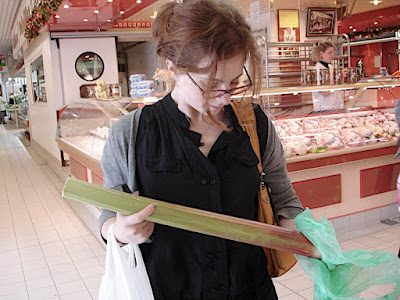
Post-coffee, Jefe went to the Centre de Création Contemporaire to check out Kasbah by Kader Attia while Rebecca wandered the pedestrian streets people-watching and window shopping. After reuniting we strolled through the twice-weekly flower market and stopped into Marché des Halles and found a spice booth selling Quinoa flour (hooray for gluten-free flours!) and a vegetable stand selling abnormally large, mutant rhubarb. It looked like a fossilized dinosaur femur and reminded Rebecca of that scene in Teenage Mutant Ninja Turtles film with the giant daisies and the ooze...

giant rhubarb in Tours
Giant rhubarb from Les Halles in Tours

In his endless quest for calories, Jefe also picked up some raspberry tiramisu at a stall selling Italian specialties.

After so much walking, we had to take a break, with wine of course. La Gazette des Halles (bistro/wine bar) was just across the street and offered inviting street-side tables. We got to sample a few local wines from Chinon and Touraine while enjoying the passing scenery until our train departure. The last drink was on the house!

When departing from (or arriving at) Gare de Tours (Tours' central train station), it is usually necessary to take a shuttle train to St. Pierre des Corps (the less centrally located train station) to catch the TGV to your destination. Apparently, the central train station is a little too central, and the since the train can't pull through (it has to back in) the time-pressed TGV doesn't want to spend the extra few minutes it would take to stop at the main station. Thus, all the TGV trains stop at St. Pierre des Corps, making it, essentially, Tours' primary train station. Which is kind of a shame, since the Gare de Tours is beautifully built and otherwise very convenient. In any case, Jefe took the opportunity on the 5 minute shuttle ride to dismantle his bike for getting on the TGV.

Jefe dismantling his bike on the shuttle to St. Pierre des Corps

Now that we can manage Tours' slightly convoluted train system, we're ready to go back to visit the annual Fêtes des Vins (wine festival) for samples of the regions wines and other gastronomic specialties along with lectures.

Emboldened by the weather and the local scenery and food, we had barely returned to Poitiers before we were planning our next bike+train day trip. This time south, to Angoulême. While we were waiting for a break in Rebecca's teaching schedule and the sunny weather to coincide, Jefe rode to Bellac and took the TER (Regional Express Transport) back to Poitiers to see some new territory and check out the bike-accessibility of the slower, smaller, TER trains.

Jefe's 142 km route to Bellac was clearly not the most direct route, but he designed it to investigate all those small, squiggly, green lines on the Michelin map just south of Bellac that indicated narrow roads, scenery, and large hills. He found some truly lovely sights.

view from the hills south of Bellac
The view from Les Monts de Blond into the department of Haut Vienne

The last train for Poitiers leaves Bellac at 6:08 pm, so Jefe had to start his ride from Poitiers at 10:30 am to leave enough time for a food break and slower riding through the scenic, hilly areas. The food break didn't happen on schedule as all the small-town grocers were closed for lunch until 3 pm or later instead of the expected 2 pm. When he finally found some food in St. Christophe, he was hungry enough to devour an armload of fruit.


2 oranges, 3 bananas and pear in front of a 12th century church

He also picked up a few savory pastries in Bellac at the local traiteur before boarding the train.

The TER trains were very comfortable and were bike-friendly, no disassembly required (the limit of 4 bikes per car was far from met).

bikes on the TER
Bike spaces on the TER

An hour and half later he was back in Poitiers, ready to eat more food.

Once the weather and Rebecca's schedule cooperated we were off to Angoulême. Jefe by this 133 km route and Rebecca by the afternoon train after a morning meeting at work. The wind forecast at France meteo was mistaken (their forecast of rain was also mistaken, and thus France meteo is getting deleted from the list of weather bookmarks) and Jefe was a little late to the rendez-vous after riding into a headwind for 5 hours.

We wandered the winding streets looking at murals from graphic novels/comic books (Angoulême is the site of a graphic novel/comic book museum and annual graphic novel expo)...

mural near Eglise St. Andre in Angouleme
Comic book mural in Angoulême

...sat in cafes sipping and people-watching and picked up some quinoa flakes at a health-food store. The young residents of Angoulême all seem hot on the trail of the latest trends. Besides some gel-enabled hairdos, we saw lots of examples of the return of 80's fashion that is so popular (see here, here, and here) as well as numerous fanny-pack-as-reversed-messenge-bag.

fanny packs coming back in Angoulême
Slightly blurry, but you can clearly see the fanny pack on the chest,
with strap worn over the shoulder


Dinner time arrived and we were off to La Cité to fulfill our increasingly frequent seafood cravings. It was delectably satisfying. We had salad with prawn tails and sautéed fresh foie gras, pan-fried goatfish in basil cream sauce and a skewer of prawns, shrimp and scallops. We can still taste it a day later, any more trips to Angoulême will definitely include a stop at this restaurant. We were so stupified by the delicious seafood, creamy sauces and wonderful wine, we had to belatedly dash out of the restaurant, running 4 blocks to the train station to catch the last train to Poitiers. We hopped on just a few seconds before the doors closed and Jefe quickly dismantled his bike aboard before the conductor approached and punched our tickets. A little sweaty and happy, we were glad to be heading back home to Poitiers for the night.

Saturday, April 4, 2009

Paris from the Perspective of a Non-French Person

The purpose of this post is to give guidance to tourists and visitors to Paris (and other French tourist towns).  If you want to add to our commentary or dispute some point we've made -- please do so in the comments!!  
Thanks --ARAD
image from smh.com.au

We hope you've been well as we've been traipsing around Poitiers and Paris with Jefe's family.  (And thank you if you are still reading...)

Now that we've been to Paris three times as "resident aliens" (i.e. not counting the times we came before moving to France), we feel like we're beginning to know our way around, which areas we enjoy and which ones to avoid like the plague. 

When people visit Paris, they think all the people they see (at least all those who aren't looking at maps) are Parisiens. Well, that probably isn't the case. While exact numbers are hard to come by, Paris is host to at least 9 million non-French tourists every year, and at least that many French tourists.

Some people (e.g. us) try and hide the fact that they are tourists so that the waiters don't start speaking English before you even sit down. To be hired in a restaurant or cafe in Paris, it's clear that you must prove that you are fluent in French and English. I think preferential treatment must also be given to applicants who have cultivated a special blend of hackneyed "bad English" pronunciation, patience, and a side of caffeine addiction. Unfortunately, Jefe and his backpack and unfashionable coat are usually a give-away. But that's ok, because we ride bikes, we go places most people don't, avoid the places that most people flock to, and we even save some cash at lunch by packing a snack to eat in the numerous parks and gardens (when it isn't raining/freezing).

Paris can be a little intimidating because it feels like everyone is judging you, and they are, the French being an especially opinionated people. The way you dress (she's not wearing black?! OMD --"ouh mon dieu" the French equivalent of OMG), where you eat, what you drink (a Pinot Noir from Alsace with veal liver?!?!?), how you tie your scarf.

Correct:
french scarves


Incorrect:

Even which hand you hold your fork with. It's very difficult to switch from the zig-zag style of eating to the Continental style. Almost as difficult as learning to write with the opposite hand. But, it's worth it to teach yourself, especially if you are the type of person (e.g. me) who thinks that the patrons and waitstaff in French restaurants are surreptitiously watching you cut into your food and silently judging you. Maybe if you learn to eat properly, they won't think you're a tourist. Oh wait, everyone is a tourist.

Nowadays, we don't have to look at the map quite as often, and even I know which way north is and how to get to the airport (I'm even getting good at helping out lost tourists). I could also give pretty good directions around Le Marais, one of the trendy shopping areas in the 3rd and 4th arondissements.

We're always looking for weird art, and Paris is happy to oblige with many controversial exhibits (which they've conveniently labeled as such). Since the worst minority oppression takes place in the suburbs, Paris has to import their controversy. In this case, from the U.S. in the form of David LaChapelle.

One photo from the series "Jesus is my homeboy" by David LaChapelle

And since I like making lists, here's another one:

How To Look Like a Tourist in France: Top Ten
1. Ask someone for directions.  Extra points if the person turns out to be another tourist.
2. Wear jogging shoes.  Extra points if they're white.  (I still walk to the gym already wearing my gym clothes.  I also--gasp--leave the gym, visibly sweaty, still wearing said gym clothes, and walk home.  I know that it identifies me as a foreigner, I just don't care.)
3. Sport multi-colored eyeshadow, fake bake, or cakey foundation.  French girls typically go for "le smoky eye" look with neutral face and lips.

le smoky eye

4. Wear anything that is visibly optimized for comfort.  Fleece is an excellent example.
5. Count with your hand incorrectly: the French start with the thumb, not the index finger.
6. Hesitate for more than 10 seconds when someone asks you a question in French.  You will know that 10 seconds have passed because he or she will repeat their question in English.
7. Only order a plat instead of the whole formule. Extra credit if you order the wrong kind of wine, too. 
8. Stop in the middle of the street to take pictures of a building.
9. Travel in a group of more than 5 people.
and of course...
10. Start speaking.

Wednesday, March 25, 2009

WTF?

We've been fortunate to be hosting a few visitors lately. We're trying to impress them as much as possible with our intimate knowledge of Poitiers and French culture. This can be a little time consuming. So while we gallivant around Poitiers and Paris, pointing out French quirks and foibles, here are a few photos to keep you entertained until we get around to writing again...

Jefe and Josh eating desert from Claud Lafond, the local high-end pastry shop
Jefe and Josh eating dessert from Claud Lafond, the local high-end pastry shop (by Rebecca)

La Serrurerie
La Serrurerie (by Josh)

Parc Blossac at Night
Parc Blossac at Night (by Josh)

L'Isle Jourdain
The town of L'Isle Jourdain along the Vienne River (by Jefe)

Grand Prix de Buxerolles
The Grand Prix de Buxerolles, 12 laps totalling 155km (by Jefe)

Eglise St. Pierre in Chauvigny
Eglise St. Pierre in Chauvigny, immaculately restored (by Jim)
***Just wanted to clarify that Jefe meant that the picture was taken by Jim.  
Jim did not immaculately restore the Eglise St. Pierre.
-Rebecca's edit 4/1/09

Thursday, March 5, 2009

Tourist towns without any tourists

Rebecca's students were on vacation again last week, and since we've got some visitors coming in a week, we decided to preview some local destinations that people might (or might not) find interesting to visit. We had two criteria: things we haven't seen, and train access.

While the winter in Poitiers has been pretty mild by Jefe's standards, the sun has been playing hard to get. And poor Rebecca grew up within two hours of the East Coast of the U.S. and has been craving the beach since we left Wilmington. We quickly settled on the sunny, seaside locale of La Rochelle as the perfect destination. In order to maximize the discovery factor, we were looking for another destination close to La Rochelle. Following the local train routes and trying not to stray far from the sea, we decided on Rochefort.

When Rebecca mentioned this duo of destinations to people, trying to solicit ideas for things to do in the area, she got a bevy of similar responses.
La Rochelle: Oooh, how nice, you're going to love it, it's beautiful!
Rochefort: Hmmm...(Silence).

Well, La Rochelle is nice. A popular summer destination for French and English tourists, the area boasts one of the highest concentrations of vacation homes in France. There are almost as many hours of sunshine every year as the Mediterranean coast but without the endless stretches of beachside hotels that you find in Nice.


Nice, France: land of beaches and hotels

Despite its un-Nicey-ness, La Rochelle remains a primarily tourist-driven economy. Restaurants have different hours hors saison (out of season) or are closed entirely for their congés in late winter; hotels are cheaper; some museums/attractions are closed. It's not as though we're panting to fight the throngs during the Festival Francopholie, but there is something a little odd about port-side restaurants in a tourist haven who have to fight for the few off-season visitors. We even spotted one restaurant with a designated crier, an older woman standing out front listing the delicacies inside in a loud voice to no one in particular.

Even though some of the posted menus of the restaurants in the tourist area looked interesting, we were disconcerted by the prospect of having people watching us eat, peering in the restaurant windows and trying to determine if you're enjoying yourself enough to merit them coming inside to try it.


Port-side restaurants in La Rochelle...probably to be avoided

Luckily we were able to find excellent restaurants away from this area. La Rose des Vins was wonderful, small, earthy restaurant serving traditional French fare with a little bit of a twist, and occasionally featuring ethnic cuisine from around the world (Jamaican chicken). They also have an extensive wine list, with some wines available by the centimeter (get a bottle and only pay for what you drink), and excellent recommendations.

We also stumbled upon Le Cabanon des Pêcheurs while craving a seafood restaurant. Baked oysters topped with melted cheese, salmon terrine, and fish with spanish chorizo were more than enough to satisfy our urges. And Jefe couldn't pass up a post-meal rhum arrangé (rum with fruit soaking in it) as the giant jars (pineapple, passion fruit, strawberries, and more) were lined up enticingly on the bar.


Lovely Rhum arrangé at Le Cabanon des Pêcheurs

We also wandered along the coastline and the ramparts of ancient castles. And, perhaps even better, we went to the sprawling central marketplace, got snacks, and took them to the beach. We ate our picnic while basking in the sun. Sublime.

●●●

Rochefort-sur-Mer (as opposed to en-Terre) was just a short train ride away. We noticed something odd about it almost immediately. The city blocks are square! How un-French. Apparently, it was a planned community started in the 17th century as a naval base and shipbuilding yard (wiping out the former pesky Protestant town that was there before). The military influence led to the straight streets and right angles.

Apparently, Rochefort is one rung down on the tourist ladder from La Rochelle, it was mostly a ghost town in late February. There are a few interesting things to see (as our extremely enthusiastic hotel personnel pointed out), notably the Maritime Medical Museum, the house-cum-museum of Pierre Loti (author, seaman and general eccentric), and the rebuilding of the frigate Hermione (which La Fayette used to aid in the American revolution).

On top of everything, it seems we picked up some nasty stomach bug while we were there. Not so nice. Reminded us a little of our friends Jessie and Tom, who came home from their honeymoon early because they got sick. And bored.

Well, we stayed it out, but we were happy to get back to good 'ole Poitiers. And now we have the first of our visitors to look forward to, the Jefe's brother, Josh...we can't wait!

Wednesday, February 25, 2009

Travel Math

Now that I've been riding a bike through the countrysides of Poitou-Charentes for nearly five months, new roads and towns are getting harder to come by. I've covered some of the smoother, more scenic routes dozens of times. In order to expand the limits of my cycling universe, exploring more routes and towns farther from Poitiers, I've decided to combine the two most convenient forms of travel here, bikes and trains.

Instead of biking in loops, always ending up back home, I've decided to try riding one way and taking the train back. The weather has been improving and I'm in much better shape than when I got here, making longer rides much more enjoyable. In addition, I can eat lunch and spend an hour or two exploring a city before hopping on the train back to Poitiers with my bike.

First destination: Niort.
Niort is around 80km from Poitiers, and is almost the same size. Biking there takes about 3-3.5 hours. Since Rebecca's students don't have class this week (because of Carnaval? Or Ash Wednesday? We're not really sure) she decided to take the train to Niort so we could have lunch together and explore on foot.

First step: Wake up early. Normally, I ride in the afternoon, but to make it to Niort in time for lunch, I'd have to leave by 9:30am. The trains stop running before I would be able to finish dinner, so I have to stick with lunch.


Wake up Jefe!

I got to Niort a bit before Rebecca's train was scheduled to come in, so I rode around a little to familiarize myself with some of the parts of town. Then I went to the train station...


...where I met Rebecca and got to change into real clothes (which Rebecca had kindly brought for me).

We found a nice place for lunch. Actually, we were looking in the window of a random place and then a customer came out to smoke his post-lunch clope, and he pretty much forced us to go in.

We sat down to recount our adventures of the morning. Rebecca *just barely* made it to the train on time thanks to the self-service ticket kiosks and their convenient option to "buy a ticket for a train that is departing immediately." Jefe found a really nice route from Poitiers to Niort with lots of smooth roads, nice scenery and not much traffic.


The part between Mothe St. Heray and Chavagné is especially nice, with views down into the neighboring valley.

Rebecca ordered une salade de thon, and Jefe had the plat du jour: roast chicken with spanish rice. We had just about finished up when...

--ok, now I have to recount an exchange I had with the waiter at lunch. It's embarrassing for me, but I feel that it bears an important lesson about French café culture--

...after the meal (in french)

Waiter: Vous êtes terminés? C'était bien? Vous voulez un dessert?
All done? How was it? Would you like some dessert?

Me: Non, merci, euh... {il donne un coup d'oeil a Rebecca} un dessert, peut-être?
No thanks, uh...{glancing at Rebecca} how about a dessert?

For some reason, I thought he had asked if I wanted the bill (l'addition). Perhaps it was my fatigued state, I'm not sure. Besides the obvious humor in rejecting and then asking for the same thing in a single sentence, Rebecca reminded me of two things one must understand about French waiters: (1) they will never offer the bill, and will wait until you ask for it (unless you're just getting coffee or drinks, or if you're in Paris & are perceived by the waitstaff as incompetent to do such things properly) and (2) they will always offer dessert. How I could have mis-heard and failed to take into account these two cardinal rules of the café, I will never know.

Giggling, we wandered through the streets of Niort, stopped by the Donjon, and island hopped in the middle of the Sèvre Niortaise River. We also saw this interesting alternative to standard bollards.


Serpent guarding the pedestrians from the evil cars

When it came time to leave, we got tickets for a local (TER) train to Poitiers. I packed my bike up for the train ride and covered it with a fitted bedsheet that Rebecca got that morning just for this purpose.


So much easier than taking it fully apart!

Everything worked out great. I got to try out some new roads, and we both got to explore a new place. This leads me to my new Theory of Travel Math:


more sweet math, for all you nerdfighters

Friday, January 30, 2009

Toulouse, Part II: ROCK the boat

Are you ready to ROCK...with bunnies?!?!

So, about that boat. Turns out it's really a permanent music venue.

While a canal boat (Cri de la Mouette) is certainly an unusual location for a rock show featuring four bands (plus DJs), Jefe didn't think too much of it. Canal boats used as houses, restaurants, and bars are not so uncommon in certain places (Amsterdam especially, but also Paris). And while the outside looked a little grungy, the name matched, and the gangplank was sporting the same poster we'd seen, so it must be the place. Another reassuring sign (depending on how you look at it): the canal seemed pretty stagnant and shallow, so it didn't look like the boat was going anywhere.

Armed with this news, we rendez-vous'ed at the Cinema Utopia for Idiots and Angels, an animated film by George Plympton. It was without dialogue or embellishment, and was very well done. The underlying question to the audience is "What if you didn't get to choose whether you or not you do good?"

be good, dammit

Post-film and craving some spicy food, we were off to Baan Siam, a Thai restaurant Rebecca found on the internet (the guidebook, and even local publications, are completely devoid of information about Asian and Indian restaurants). While it was nearly empty when we got there, the waiter wanted to make sure we would finish in an hour as they were fully reserved starting at 9pm. I guess that's a good sign. We asked for our dishes très très piquant (very, very spicy) and were a little more than surprised to actually receive them that way. Jefe was sweating and blowing his nose from the hot peppers (just the way he likes it). We finished with some coffee ice cream to soothe our deliciously tortured tongues.

Leaving the restaurant, we were a little worried about being late for the start of the show and that the tiny canal boat would already be at capacity. Upon arriving, we learned that we couldn't board because the show wouldn't start for another hour (although we had some suspicions that we were turned away on the grounds of not being sufficiently hip). So we walked down the street (to a more upscale establishment) for a drink while we waited for the cool kids to decide that the magic hour had arrived and we could give them our money and come aboard. After the waiting-drink, we checked back, and saw there were still people loitering outside the boat. Since the show apparently still hadn't started, and since we had perhaps already been deemed not cool enough to enter when it did, we headed to a more distant bar to bide our time until the doormen were too stoned to care who they let in.

At some point while we were killing time, we found (to some surprise) our mysterious aquatic venue listed in not one but both guidebooks. Perhaps this was a legitimate operation after all, and not merely some squat turned music venue that required a certain haircut for entry. Reenergized, we turned around and made it inside in time to catch the first act, The Pumplies. Needless to say we were surprised. Not only was the music good (most of it awesome even), there was alcohol and bathrooms (that the awesome musicians occasionally puked in). So we ended up staying for all the bands. There was only one dud in the bunch (perhaps because, unlike the other bands, they lacked a female member), Wild Women and the Savages, which reminded us of the SNL spoof show Sprockets. However, the (male) guitar player was wearing a button-down suede mini dress, no underwear (steep stairs...you get the picture), and a lighted sign on his chest ("WW" for Wild Women), and the singer was wearing a Lucha Libre mask, so we tried to forgive them their musical shortcomings.

AWESOME BAND PICTURE
(Cristal Palace featuring singer reminiscent of 90's era Courtney Love and Ian Curtis)

NOT-SO AWESOME BAND PICTURE


All in all, a great couple of days in Toulouse dodging some pretty nasty weather. Thanks to a combination of a guidebook or two, the internet, and a little luck.

Wednesday, January 28, 2009

Toulouse, Part I: Evacuation Plan

Yes, the weather is terrible. "Violent wind, DANGER, risk of falling branches."

Our trip to Toulouse was another excellent illustration of the complexity of navigating a new place. You may recall a previous post, in which we discussed the pros and cons of relying on local publications versus established guidebooks. In that post, it's possible that we may have overemphasized the value of local guides. In fact, what we should have suggested is that reliance on a single form of travel guidance is not much better than using none at all.

We arrived in Toulouse on Thursday afternoon (Le Routard guide in hand). Once we got to the hotel, we also had the advantage of internet access (which we didn't have in Bordeaux). Et puis, it took Jefe only about four hours to find Let's Motiv, the local (free) toulousian guide, which became the third prong of our navigational apparatus.

third prong--100th edition of Let's Motiv

One of the first, and in many ways, best finds in Toulouse was thanks to Let's Motiv. El Chivito del Léo may look like a shack, but the Argentian tacos, sandwiches, empanadas, & cetera were so good that we went back two days later for more. And people who have been to Spain would appreciate the availability of San Miguel, which is, in Jefe's opinion, the best cheap beer in the world.

The next day, on the suggestion of Le Routarde, we went to the Marché Victor Hugo; the guide mentioned that the restaurants located on the upper level of the market were very good for lunch ("Get there early, or late, or prepare to wait," it said). What the guidebook didn't say was that in order to get to the restaurants, you have to go through a fire door, ride in an elevator of death (some graffiti on the inside warned that pushing on the door while in transit would cause it to spontaneously open) and walk down a spartan hallway. In fact, the only clue we were on the right track was this placard of the evacuation procedure noting the location of us and the nearby restaurants.

Vous êtes ici

Once we found them, everything went well. We walked through all the restaurants (since they lack separating walls, this is a little awkward, and the only way to tell them apart is their chosen color scheme) and finally chose Attila, which specializes in seafood. We had dorade carpaccio, shrimp risotto (unbelievably good, I think it may have had veal stock in it), and three small filets of different kinds of fish fresh from the market below. Don't forget the crème brûlée, mousse au chocolat, a little wine, and two p'tits cafes all for a reasonable price.

After lunch, Jefe went to Les Abbatoirs (the contemporary art museum, which had an exhibit by Antonio Saura, a series of paintings reinterpreting the Pinoccio story, and more abstract art),

Crucifixion by Antonio Saura

and Rebecca went in search of vintage clothing, books, and perhaps a small suitcase for our increasingly frequent train excursions. Just before separating, as we were walking off our wine, we noticed this unusual poster and took a picture (we'd recommend this to those of you who travel with a digital camera; it's often easier than writing stuff down, and you can avoid misspellings and incorrect times/dates).

It tooks us a few minutes to decode the alternating color typeface. The difficulty in telling where words begin and end (is that Cride la Mouette or Cri de la Mouette?) caused the ensuing internet search to take a little longer.

After the museum, Jefe looked up the address of the venue, Cri de la Mouette, on the internet. The address listed on Google was merely a street with no number (Allée de Barcelone), and so Jefe went to check it out to avoid prolonged wandering in the dark later. What he found was this:

is that...a boat?

to be continued...

Saturday, January 24, 2009

Bordeaux, Part I: Finest Food in Finest Town (?)


follow the wet cobblestones

In this, only our second francophone foray from Poitiers, we headed south to Bordeaux and Toulouse. Since both are fairly large and populous, and because we had never visited either place before, we did get guides (in French) for the two cities.

Really, a guidebook is just a starting point, something that you can use for the first day or so (maybe even just the first 4-6 hours). We feel the need to stress this point. The guidebook should be a handhold to use only until you get your hands on some local publications that will give you the lowdown on the currently hot restaurants, music venus, movies, art exhibits, and which may even warn you of an upcoming manif (slang for manifestation nf. 1. a protest, sometimes in conjunction with a strike or grève; 2. the national sport of France; 3. something you should know about before traveling).

Finding local reviews of what's going on is probably the most underrated travel-related activity. Guidebooks are ok for finding all the 1000+ year-old churches, but they aren't going to know about the organic Thai restaurant that just opened (or the little old theatre that just shut down). And if the locals aren't that into spicy organic food (a good bet around here), it may well be closed by the time the next edition of Lonely Planet comes out. This means that you, the traveler, have a responsibility to venture outside the safe confines of the published guidebook, which you should consider out-of-date and out-of-touch even before you spotted it on the bookshelf.

There is a reason the local publications review art, restaurants, movies, and fashion--locals want to know about this stuff too! In larger cities, local publications (for instance, Pariscope in Paris, The Reader in Chicago, Spirit in Bordeaux, or Let's Motiv if you're in Toulouse) give those out-of-the-way, non-corporate, and newly-opened, but still solid establishments a fighting chance against the overpriced robo-bistrots in the tourist district.

Enough of our hipster politics. 

So anyway, after our apartment almost burned down, we hopped on the TGV in Poitiers and were in Bordeaux in two hours, a short tram ride later, we were at our hotel. We'll never get over the ease of transferring from one form of transport to another here (TGV to bus/metro, airplane to TGV/bus/metro).  You know that feeling you get when you have to walk the five blocks from Chicago's Union Station to the nearest El stop dragging two suitcases in the snow? Well, not here!

In the middle of a vast network of streets for pedestrians and bikes only, we were surrounded by restaurants and boutiques. We found a great breakfast/lunch spot, Karl Restaurant, around the corner from our hotel.  

Karl--"Finest food in finest town"

Located in the Place du Parlement, the interior is very airy and the sun shines in the windows in the afternoon (well, theoretically.  If the sun ever shines in Bordeaux). 

It was also a fun people-watching venue.  For instance, we watched this mother (picture to the left) tying her baby to a chair with her designer scarf.  It's hard to imagine a mother doing this in the US.  It might even be illegal.   It was very chic, but it didn't last long (baby was relocated to dad's arms, scarf returned to mother's shoulders).


If you make it to Karl's, don't forget to visit Cousin et Compagnie, the caviste across the street (their motto is: The importance of a wine shop? That it stays open! --W.C. Fields), where we got this excellent and very wine/cheese/bread-appropriate wine...

Other good food finds were Bar-Cave de la Monnaie (classic-cosy french) and Occitane Cafe on the Place du Palais, classic french, but cheap, and more lunch-appropriate.

While in Bordeaux, don't forget to get a glass of Lillet in between meals, while shopping, or in between art exhibits.